Top

海角视频

faculty

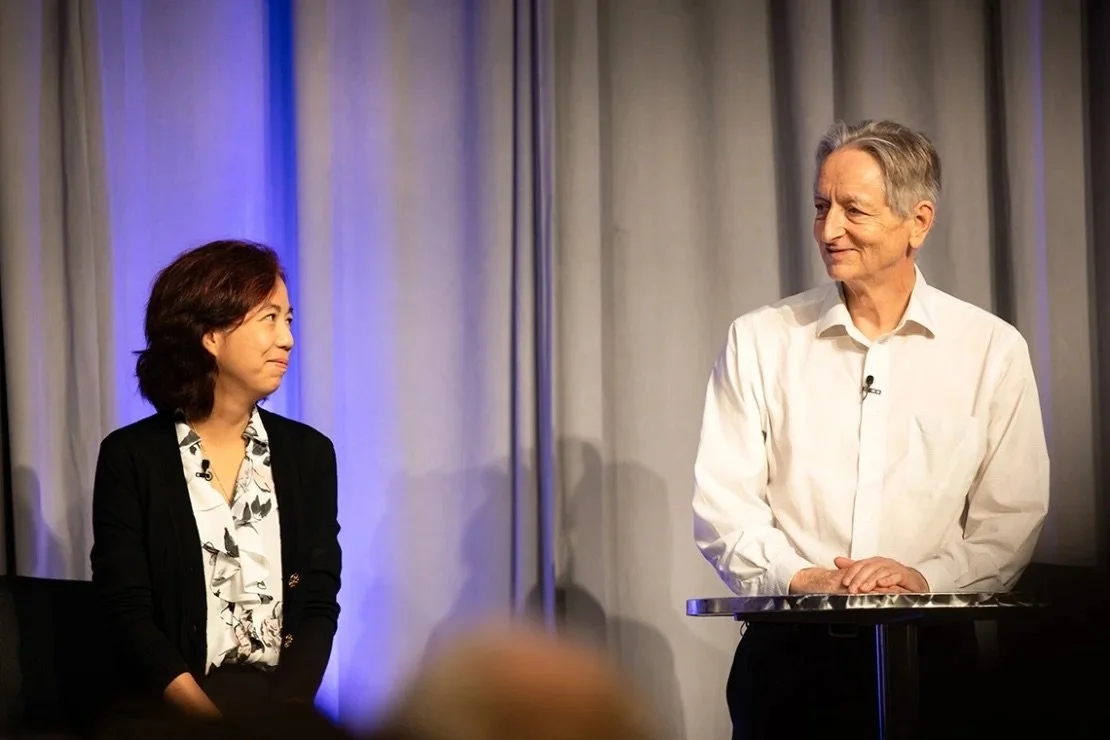
Geoffrey Hinton to give scholarly talk on whether AI will eclipse human intelligence

Geoffrey Hinton stands at a podium and looks off to the side.

Geoffrey Hinton will be giving an academic talk on artificial intelligence at Convocation Hall on Oct. 27. (Photo: Polina Teif)

After with his warnings about , will be engaging directly with researchers and scholars at a University of Toronto event. 

A U of T Emeritus in the 海角视频 of Computer Science who is often referred to as 鈥渢he godfather of AI,鈥 Hinton will tackle the question during an academic talk at Convocation Hall on Oct. 27. (Tickets to the in-person event are sold out, but a recording will be shared publicly at a later date). 

His lecture will be followed by a Q&A session co-ordinated by , a professor in the 海角视频 of Computer Science in the Faculty of Arts & Science who is a Canada CIFAR AI Chair and an associate director at U of T鈥檚 . 

The session will give Hinton an opportunity to directly engage with researchers and scholars from across the university regarding the revolutionary technology he helped create.  

鈥淎I is re-shaping the way we live, work and interact with each other,鈥 says McIlraith. 鈥淕iven the current public discourse about AI, it鈥檚 particularly important that scholars across disciplines learn from each other and engage in an informed exchange of views regarding the societal implications of this transformative technology.鈥 

U of T provides an ideal forum for such scholarly discourse, she adds, because of U of T鈥檚 , the 鈥渂readth and depth鈥 of expertise at the university and the city of Toronto鈥檚 position as of AI research and development. 

"The conversation around AI is no longer housed in the computer science lab or within the offices of Big Tech. It needs to be multidisciplinary to advance our collective understanding of the opportunities and the potential risks so we can work to avoid the risks while benefiting from all that AI has to offer.鈥  

The Schwartz Reisman Institute for Technology and Society and the department of computer science in the Faculty of Arts & Science are co-hosting Hinton鈥檚 talk in collaboration with the and the Cosmic Future Initiative at the Faculty of Arts & Science. 

鈥 Original story by Adina Bresge for

Humanity is at a 鈥榯urning point鈥 with AI, Geoffrey Hinton tells CBS News's 60 Minutes

University Professor Geoffrey Hinton speaks with 60 Minutes correspondent Scott Pelley about advanced artificial intelligence. (Image courtesy of 60 Minutes)

, often dubbed the 鈥済odfather of artificial intelligence,鈥 explained the potential benefits 鈥 and risks 鈥 of the technology he helped bring into existence on CBS News鈥檚 .

A Emeritus in U of T鈥檚 海角视频 of Computer Science, Hinton told correspondent Scott Pelley about his decision earlier this year to .

The cognitive psychologist and computer scientist, whose research contributions set the stage for the current acceleration of AI development, says he has no regrets because of the technology鈥檚 enormous potential benefits. But he warns that humanity is at a 鈥渢urning point鈥 in determining AI鈥檚 trajectory 鈥 and that the decisions we make today could have far-reaching consequences for the future.

鈥淚 think my main message is there's enormous uncertainty about what's (going to) happen next,鈥 Hinton told the newsmagazine program. 鈥淭hese things do understand. And because they understand, we need to think hard about what's going to happen next. And we just don't know.鈥

Team including U of T computer scientists wins ISSS 2023 Scientific Achievement Award for work on CERN Large Hadron Collider safety system

Team including U of T computer scientists wins ISSS 2023 Scientific Achievement Award for work on CERN Large Hadron Collider safety system

Professor Marsha Chechik and PhD student Torin Viger are among a team of researchers recognized with the 2023 Scientific Achievement Award from the International System Safety Society. 

Researchers find 鈥榰nified foundation鈥 of word meaning in child language development and language evolution

Researchers find 鈥榰nified foundation鈥 of word meaning in child language development and language evolution

New research, co-authored by Associate Professor Yang Xu, demonstrates that word meaning extension, observed in both children and the historical evolution of language, relies on a common cognitive foundation of knowledge and how things relate to each other.  

The Godfather in Conversation: Why Geoffrey Hinton is worried about the future of AI

The Godfather in Conversation: Why Geoffrey Hinton is worried about the future of AI

In The Godfather in Conversation, Geoffrey Hinton explains why, after a lifetime spent developing a type of artificial intelligence known as deep learning, he is suddenly warning about existential threats to humanity. 

Influential Paper Award: International Conference on Automated Planning and Scheduling (ICAPS 2022)

Influential Paper Award: International Conference on Automated Planning and Scheduling (ICAPS 2022)

Alumnus Christian Muise and professors Sheila McIlraith and J. Christopher Beck received an Influential Paper Award for their 2012 paper, 鈥淚mproved Non-deterministic Planning by Exploiting State Relevance.鈥 

Richard Zemel receives 2023 CAIAC Lifetime Achievement Award

Richard Zemel receives 2023 CAIAC Lifetime Achievement Award

The Canadian Artificial Intelligence Association has presented Professor Richard Zemel with a 2023 CAIAC Lifetime Achievement Award in recognition of his outstanding research excellence in artificial intelligence during his academic career.  

Alec Jacobson wins CS-Can/Info-Can Outstanding Early Career Computer Science Research Award

Alec Jacobson wins CS-Can/Info-Can Outstanding Early Career Computer Science Research Award

Alec Jacobson has been named a 2022 recipient of the Outstanding Early Career Computer Science Research Award. The honour recognizes CS faculty members at Canadian universities who have made significant contributions early in their academic careers.

Transforming education through AI-powered adaptive experiments: U of T computer scientists鈥 team wins XPRIZE Digital Learning Challenge

Transforming education through AI-powered adaptive experiments: U of T computer scientists鈥 team wins XPRIZE Digital Learning Challenge

The Adaptive Experimentation Accelerator, led by Assistant Professor Joseph Jay Williams, aims to design inclusive and personalized learning experiences.