
In 1955, researchers including Professor Kelly Gotlieb (far left), observe as Audrey Bates operates a telegraph machine connected to the Ferranti Mark I (FerUT), the first electronic computer in Canada.
What started with just a handful of professors and graduate students has grown into one of the top computer science departments in the world, holding the number one spot in Canada.
U of T鈥檚 海角视频 of Computer Science is now celebrating 60 years of groundbreaking contributions that span personal computing, theoretical computer science, software systems, graphic design, artificial intelligence and beyond.
It has grown into a thriving community of 2,500 undergraduates, 600 master鈥檚 and PhD students, and thousands of engaged alumni. The department鈥檚 outstanding research has impacted nearly every facet of modern life.
鈥淎fter six decades, our primary focus remains on the students and learners,鈥� says , professor and chair. 鈥淲e are committed to preparing the next generation of computer scientists with the skills, knowledge and ethical grounding necessary to navigate and shape the rapidly changing landscape.鈥�
Booting up the computer age
The advent of digital computing after the Second World War created unprecedented opportunities for academics. The late University Professor Emeritus , together with Professors and , who are no longer with us, recognized this potential and launched the Computing Centre at U of T in 1947.
For the first time in Canada, U of T scientists were using computers to advance key research in math, engineering and the social sciences, and actively engaged in global discussions about computing's future. Gotlieb authored one of the first computing textbooks in 1951 and played a key role in bringing Canada鈥檚 first electronic computer, a Ferranti machine nicknamed 鈥淔erUT,鈥� to the university in 1952.
鈥淲ith Ferut,鈥� Gotlieb told the Toronto Star at the time, 鈥淲e will be training men and women how to operate electronic brains.鈥�
In 1963, Gotlieb and his colleagues argued for a department's creation.
鈥淐omputer science has developed to the stage which justifies such a centre, that it is strongly interdisciplinary and does not properly belong to any existing department, and that faculty, students, and equipment are available to ensure that original research can be done,鈥� Gotlieb wrote to administration.
DCS: A world leader
In 1964, the founding of the 海角视频 of Computer Science signaled the next era and a new level of respect on campus. Gotlieb was named the first chair and worked with Hume and Hull to recruit top talent.
U of T researchers were some of the first to tackle questions of theoretical computer science, and the Dynamic Graphics Project was behind the early development of graphical interfaces that forever changed how we interact with computers.
In 1971, University Professor Emeritus published his first work on computational theory, which suggested computers can鈥檛 solve every problem in the universe. For the groundbreaking "Cook's Theorem,鈥� he won the Turing Award, often referred to as the Nobel Prize of computing.

University Professor Emeritus Stephen Cook was honoured with the Turing Award in 1982 for his work on computational theory. 鈥淐ook鈥檚 Theorem鈥� proved that computers cannot solve every problem in the universe. His contributions to computer science are celebrated around the world. Photo: Makeda Marc-Ali.
The department continued sending brilliant graduates into the world throughout the 1970s, including Ed Lazowska, who earned his PhD in 1977 before an impactful career at the University of Washington.
鈥淭he department is one of the world's preeminent computer science programs. I had an amazing experience, and with every passing year my appreciation deepens,鈥� says Lazowska.
In the 1990s, the department expanded into emerging areas such as computational biology, networking and distributed systems. And the faces of the students and faculty were changing, too.
Professor was the only female faculty member (though not the first) when she joined the department in 1986, and she was determined to create a more inclusive environment for the few female students at the time.
"I was asked to be the associate chair and as every good academic knows, when asked to take on a role, it is the time to negotiate for additional resources,鈥� says Ellen. 鈥淥ne of my conditions was to get money for a monthly lunch with the women graduate students, postdocs, and faculty.鈥�
This led to the founding of DCSWomen in 1992. The group provided support for female students to learn and thrive. The program is still running more than 30 years later.
The AI revolution
Today, the department is a world leader in many disciplines of computer science, but a lot of attention lately has been focused on AI. The AI we use today 鈥� at work, home and school 鈥� stems largely from research on neural networks by University Professor Emeritus .
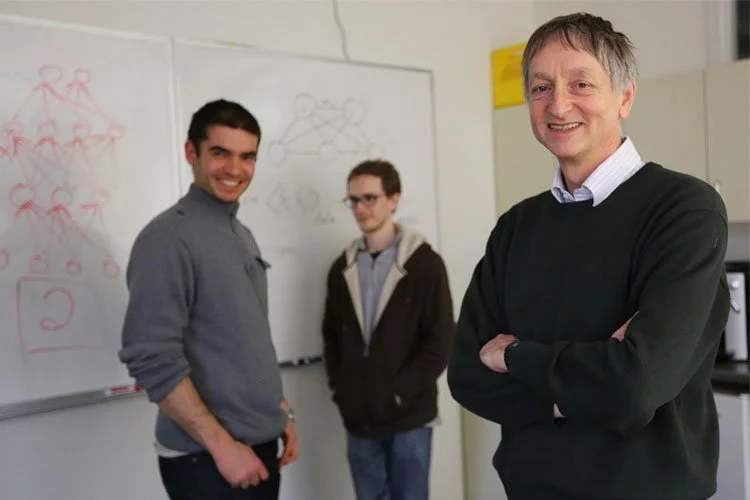
University Professor Emeritus Geoffrey Hinton with graduate students Ilya Sutskever (left) and Alex Krizhevsky (right). In 2012, Google acquired their startup company for its research on deep neural networks, which involves helping machines understand context. Photo: Johnny Guatto.
In 2012, Hinton and two of his U of T students developed a deep-learning-based visual recognition system that won an international competition, achieving human-level accuracy for the first time. Hinton鈥檚 contributions earned the department its second Turing Award in 2018.
鈥淗inton deserved much of the credit for Toronto's meteoric rise to industrial AI research prominence,鈥� says Professor . 鈥淎nd this new industrial AI research sector has provided fantastic opportunities for our own students to stay in Canada rather than flock to Silicon Valley.鈥�
The department turns 60
Events are planned throughout the academic year to celebrate the 60th anniversary. Highlights include the prestigious C.C. "Kelly" Gotlieb Distinguished Lecture Series, featuring a public keynote by Waabi CEO & Founder, Professor . And in November, the department is holding its largest showcase, where members of the program and other grad students, show exciting innovations that could spark positive change and transform global industries.
鈥淲e are celebrating the educational, research and innovation impacts of the department,鈥� says Professor , who chairs the 鈥�DCS Turns 60鈥� committee. 鈥淢any of our grads are identifying and solving problems where software can have a positive impact on society 鈥� there is a lot to celebrate.鈥�

Raquel Urtasun, a world-leading expert in machine learning and computer vision, speaks about an autonomous vehicle from Waabi, the startup founded by Urtasun. Photo: Nick Iwanyshyn.
The anniversary also has many people thinking about the next 60 years. University Professor says computer science at U of T thrives because of a longstanding commitment to bringing in the right people, whether that鈥檚 a new professor or an office administrator.
鈥淭he culture of this department has always been that your success is my success,鈥� says Borodin, who co-authored the 1973 book, Social Issues in Computing with Gotlieb.
鈥淚 think we'll continue to be one of the best universities in the world for computer science for many years to come.鈥�
鈥� Original story by David Goldberg for